
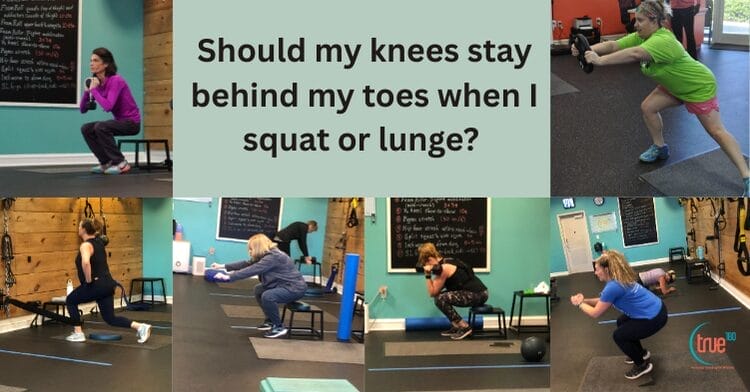
Q: Should my knees stay behind my toes when I squat or lunge? (Is it dangerous, or bad for my knees if they move forward?)
A: Before I answer, I want to acknowledge the debate between the “never over toes” and the “always over toes” schools of thought. Meaning there are some folks who say our knees are harmed if the knees ever go over the toes, and those who say we can cure knee pain and improve athleticism by pushing the knees as far forward as possible. Both sides say the others are uninformed, inexperienced morons.
The truth is that both sides are wrong:
- “Never over knees” are wrong in that
- there’s nothing inherently dangerous about the knees moving forward, and we’ve never had good evidence to say that it is.
- Restricting the movement of the knee “dries up” the knee (meniscus especially), and increases pressure on the low back and hips about 1,000%.
- “Aways over toes” are wrong in that
- Nothing works all of the time for everyone
- They’re taking a good idea too far. The good ideas are that
- Our knees are designed to move, and require movement to be healthy (the converse – our knees get stiff, weak and brittle when rested – is true).
- For knee pain rehabilitation, letting/encouraging the knee to go forward does seem to work better than restricting it.
- I guess you could say the “over toes” folks are less wrong, but that’s not the same as saying they’re right. It is true that avoiding knee movement is harmful to the knee, but that’s not the same as saying that all people will benefit from pushing their knees as far forward as possible.
Bottom Line on Should my knees stay behind my toes?
Focus on using your maximum pain-free range of motion regardless of how your knees and toes do/don’t line up. We all have different bodies that have different lengths of thigh bones, feet and torsos, etc. and all of these things determine how far forward your knees will move relative to your toes.
Motion is lotion. Our joints don’t have much blood supply (because internal bleeding is bad), so they depend on something called synovial fluid for nutrition and hydration. Our joints only make and distribute synovial fluid when they move through their full range of motion.
Focus on using your maximum pain-free range of motion.
More on Knees and Squats
So the next time you wonder Should my knees stay behind my toes? Or your workout partner asks, just remember to focus on your max pain-free range of motion. And feel free to share this with anyone who has knee issues. Helping women with knee issues workout is one of our specialties!
Join us at True 180 Personal Training for Women, located near Ballantyne Bowl and Harris Teeter in Charlotte, NC. Our expert trainers are here to help you become stronger, fitter, and more vibrant – no matter your age. Get started with our 10 Day Trial. We can help you even if you have knee pain. We modify all of our programming so it suits each and every T180 member to help her reach her potential each personal training session.
Josef Brandenburg, best selling author, is the co-owner and a coach at True 180 Personal Training, Charlotte’s most effective personal training studio for women since 2016. With decades of experience and multiple certifications, he shares his expertise with you including Should my knees stay behind my toes? Our head coach is Gregory Clifton who has been training at T180 since 2016 and also has over 25years of expertise. Please let us know what other questions you have about exercise and health.