Q & A: Progressive Overload. I see “progressive overload” mentioned as the key to making exercise effective online in articles and Instagram. What is it? Do we do it?
A: Progressive overload, in practical terms, simply means “making your workouts harder over time.” To be fair, there’s also the narrow-minded (and surprisingly popular) definition that says progressive overload is only about adding load (weight) to your exercises… in other words they would say if you aren’t adding weight to each of your lifts each week or month, then you’re not doing progressive overload (and they would imply what you are doing is pointless).
Problem with load only
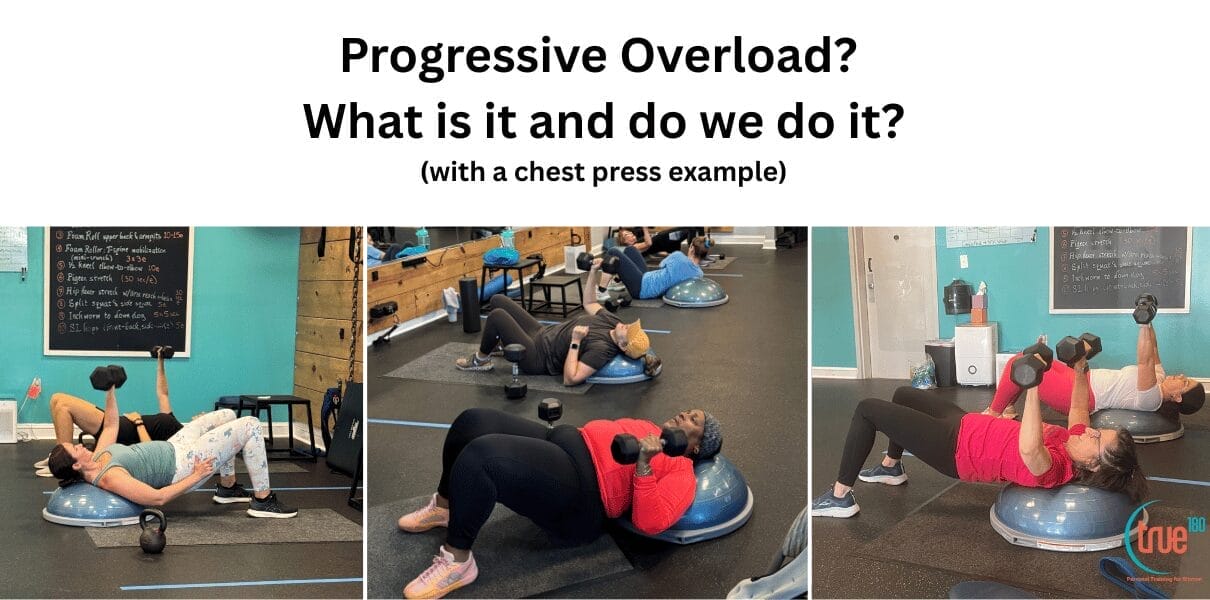
Let’s use dumbbell chest press as an example, and let’s say you are starting with 15 pounds for 10 reps. The “load only” theory of progressive overload would say that you must add 5 pounds per month to your chest press. This means that you would (should?) be able to use the 75 pound dumbbells in just 1 year. By the end of year 2 you would be using the 135 pound dumbbells, and by the end of year 3 you would be using the 195 dumbbells (390 total) for your dumbbell chest press.
If the human body could keep up with this version of progressive overload, then our dumbbells at True 180 Personal Training for women would not top out at 75 pounds, and most gyms would need a lot of 200+ pound dumbbells. I just checked with our equipment supplier, and the heaviest dumbbells they sell are 125 pounds because the heaviest dumbbells any facility buys are 120 to 125 pounds. Either everyone is a lazy slacker, or it is simply impossible to continue adding weight each month.
Back to reality: Practical solutions for women’s strength training
The good news is that there are far more options for progressing exercises than the small minded “experts” would have you believe. Here’s a short list:
Chest press specific
- Increased number of sets: going from 3 sets of 15lbs of 10 reps (450lbs of volume) to 4 sets of the same reps and weight is a 1/3rd increase in work or volume (600lbs of volume).
- Increased number of repetitions: 12 reps is 20% more than 10 reps, and if the load you are using is challenging enough, you will feel the difference.
- Increase the range of motion: if you go from doing your chest presses stopping your elbows at the bench, to letting them go below, then you will be doing a lot more work.
- Change the angle: if you were to do the presses on an incline the same load gets much heavier (it travels further and you’re at a mechanical disadvantage).
- Increase the complexity: you can do an “alternating” version of the dumbbell chest press where you press both up together, lower and lift the one, and then do the other side. This substantially increase the time under tension for the muscles and changes the challenge. There are also see-saw, squeeze, and other variations including a one arm chest press.
- Change the tempo: attempting to move the weight up more quickly requires much more work (work is ½ * mass * velocity squared).
- Drop sets: using the 15 pound example above, you could complete a set of 10 reps with the 15 pound dumbbells, then immediately do as many as possible with either 10 or 12 pound dumbbells.
Additional good news is that the list above is not exhaustive, and is not a ladder or progression. Meaning that you don’t have to start with one option and then move systematically to the next option without ever being able to revisit any other options for fear of “regressing.”
Bottom Line
To paraphrase Greg LeMonds, your workouts don’t get easier, but you get fitter. Progressive overload is using many different methods to increase the challenge on your body to maintain the progress you’ve made, and/or push forward to new levels.