Are Egg Whites Better for You?
Q & A: Are Egg Whites Better for You? I’ve been seeing on social media that I should eat whole eggs instead of just the egg whites. Which one is better for me? Whole eggs or egg whites?
A: Egg whites are better for you. No contest. I’ve never met anyone who doesn’t find it difficult to eat enough protein without going overboard on calories, and it is calories that make egg whites the winner.
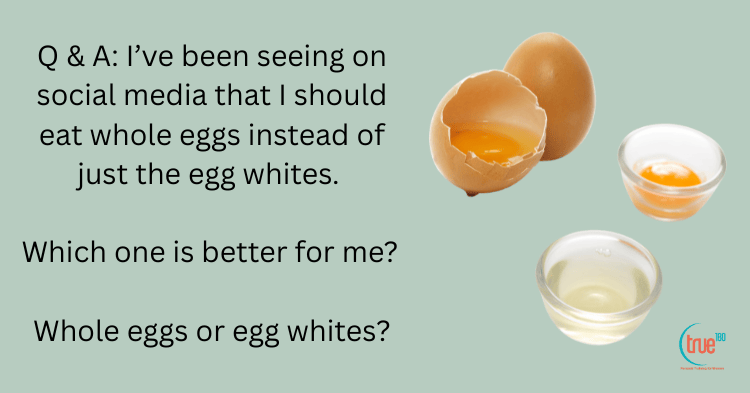
A large whole egg only has 6.3g of protein for 71 calories. The same number of calories of egg whites would have about 15g of protein. In other words, egg whites have 230% more protein per calorie.
Too Little Protein Per Calorie
Eggs, like steak, are mostly fat not protein. To be specific, whole eggs are 60% fat by calories.
Most women need ~35 of protein per meal if eating 3 meals per day. Here’s how breakfast breaks down with whole vs egg whites:
Whole eggs
- 5 ½ egg 395 calories
- ½ tbsp oil (which is a very stingy amount) 60 calories
- 1 slice toast (sad, dry toast) 75 calories
- 1 cup strawberries 50 calories
- Total 580 calories
580 calories spent on breakfast (with dried up toast that is thirsting for butter) is a lot for most women. If this is 1/3 of the daily intake, then you’ll end up eating 1,800 calories. Regardless of what you see in magazines or online, 1,800 is a lot of calories for most women.
Egg whites
- 1 1/3 cup egg white 166 calories
- ½ tbsp oil (which is a very stingy amount) 60 calories
- 1 slice toast 75 calories
- 2 pats (2/3 tbsp) butter 70 calories
- 1 cup strawberries 50 calories
- Total 421 calories
In this example we have the same breakfast, except we don’t subject ourselves to the torture of dry toast, and we saved 160 calories. Anytime you can save 100+ calories per meal you are winning.
Unscrambling Egg Myth and Fact when asking Are Egg Whites Better than the whole egg?
Unfortunately the advice to “always eat the yolk” is not qualified and is mixed in with legit myth-busting, making it harder to separate fact from fiction. (By “qualified” I mean, who is that advice useful for? In this case, it’s genuinely good advice for teenage boys trying to gain weight, but it’s mostly frequently served to middle aged women with office jobs.)
Amongst the facts mixed with the unqualified advice are the bits about dietary cholesterol: you will hear that the cholesterol you eat has little to no impact on the amount of cholesterol in your blood (like when you get lab work). That is 100% true. Eating an egg yolk a day will not give you high cholesterol*. However, the statement “egg yolks don’t jack up your cholesterol” is not equivalent to “everyone should eat whole eggs and never egg whites.” That’s either conflation or a strawman.
*Nearly all of the cholesterol in your blood was made by your body because it is so vitally important. Cholesterol is used in the membrane of every cell, your brain, your nerves, etc. You can not live without it. You can have too much of a good thing. Meaning your body can be made to overproduce by (1) eating too much fat (especially saturated fat), (2) having too much body fat (losing 5-10% of your body weight will normalize most people’s lab results), and getting too little exercise. Obviously, choosing lower calorie foods (egg whites vs egg yolks) will help with the weight loss solution.
Bottom Line on Are Egg Whites Better for You?
As Ben Franklin did not say, a calorie saved is a calorie burned. Obviously my two examples above can’t give you all of the options available to you, but I hope they got you thinking. Maybe you don’t like toast, or maybe you really like yolks. In that case you could drop the toast and butter and use one whole egg (and less whites).
Perhaps you want more fiber in your breakfast, so you could dump (no pun intended) the butter and toast in exchange for 3 cups of strawberries (~9g of fiber!)…
Here are some more ways to save calories and get more protein for not too many calories.
Lastly, if you are curious about the mythical “healthy fat,” they don’t exist.